
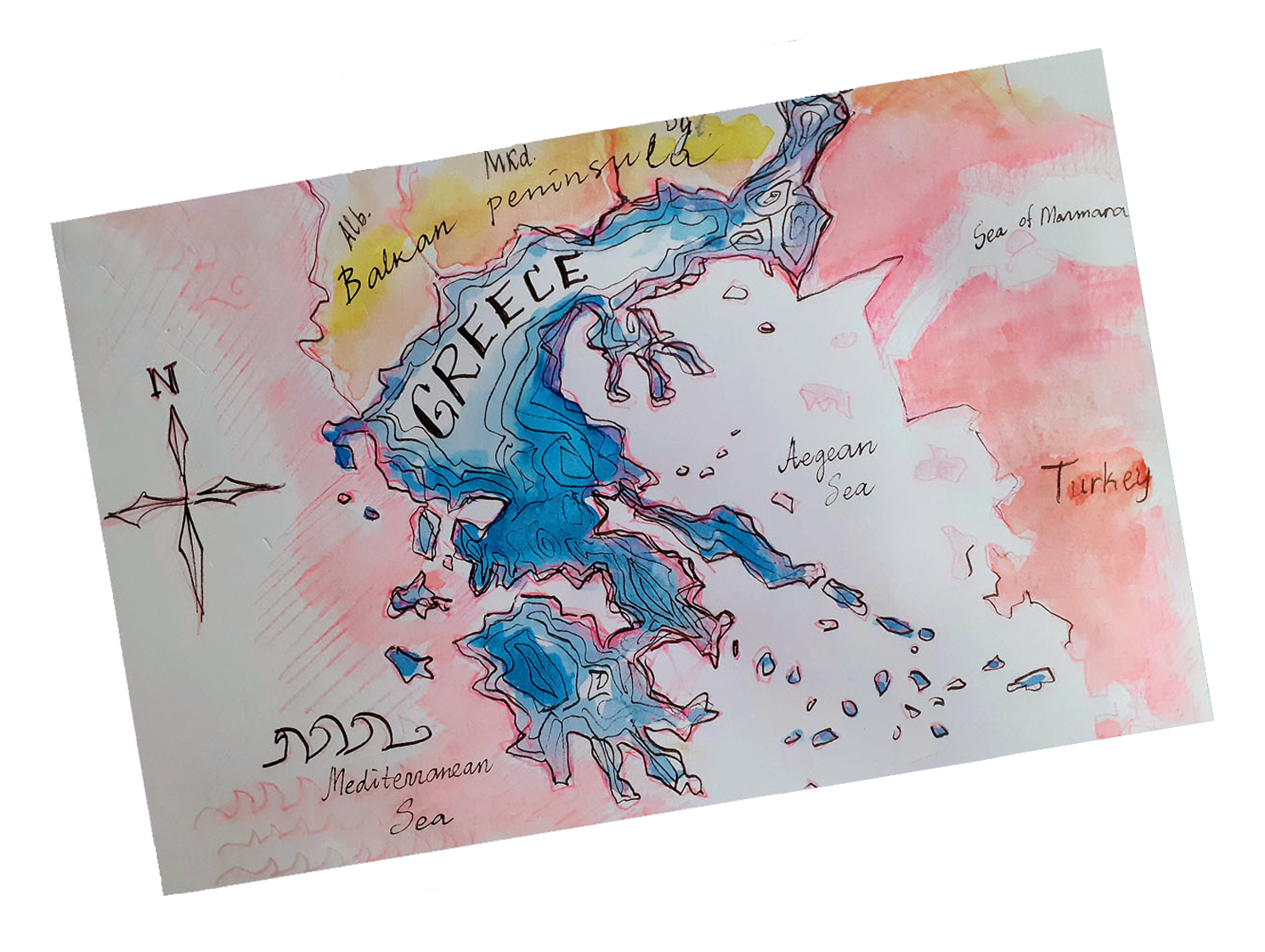
The birthplace of democracy, Greece gained independence from the Ottoman Empire in 1821. The first constitution of the Kingdom of Greece was drafted in 1844 and stated, “Greeks are equal before the law.” However, it would be more than 100 years later that women gained the right to vote and stand as candidates in legislative and municipal elections. After obtaining full suffrage in 1952, women’s role in Greek society began to shift with higher female representation in the labor force, government, and post-secondary education. The country’s current constitution was drafted in 1975, and declares, “All Greeks are equal before the law. Greek men and women have equal rights and equal obligations.” The feminist movement of the 1970s and 80s along with Greece joining the European Union in 1981, helped to lay the foundation for the Family Law reform of 1983, which among other things guaranteed equality between spouses and made divorce easier to obtain. Greece ratified the Convention on the Elimination of All Forms of Discrimination against Women (CEDAW) in 1983, and three years later passed law 1609/1986, legalizing abortion. In 2006, law 3500/2006, was passed to combat domestic violence by criminalizing marital rape and intimate partner violence. Vassiliki Thanou-Chrisophilou became Greece’s first female prime minister in 2015, and five years later Katerina Sakellaropoulou was elected the country’s first female president. Despite these notable advancements toward gender parity, the country’s firmly established patriarchal culture has hindered women from attaining equal rights. According to the 2021 Global Gender Gap Report, which measures economic participation and opportunity, educational attainment, health and survival, and political empowerment, Greece ranks 98th out of 156 countries and has one of the lowest rankings of all EU countries. Women make up a mere 21 percent of parliament and according to a 2020 study by ActionAid Hellas, 85 percent of Greek women say they have experienced workplace sexual harassment. Moreover, in 2020 a General Secretariat for Demography and Family Policy and Gender Equality report showed that domestic violence offenses were more than three times greater than a decade prior with feminist groups estimating that femicide rates were at least one per month. Fortunately, women’s rights organizations such as the Greek League for Women’s Rights, the National Council of Greek Women, and Action for Women are helping to provide a network of shelters and counselling centers for victims of violence while holding the government to account on behalf of women across the country.
The first Olympic Games were held in Elis, Greece in 776 BC. The majority of women at that time were excluded from society and banned from competing, but in 396 BC Cynisca, who was a Spartan woman from the elite class was permitted to participate. She won the four-horse chariot race, becoming the first female Olympic champion. Cynisca won the event again in 392 BC, paving the way for other Spartan women of the elite class to pursue sports competition. In the second century AD, the Heraean Games, the all-female version of the Olympic Games, was formed. The Heraean Games, named for Greek goddess Hera, are the first documented sporting events where female athletes competed against one another. In 1906, tennis player Esmée Simirioti became the first Greek woman to participate in the modern Olympic Games winning gold in the women’s singles event. In 2000 sprinter, Eleni Samaritaki was the first woman from Greece to compete in the Paralympics where she won silver in the Women’s 200 m T36 and Women’s 400 m T36. The national water polo team has established itself as one of the best in the world after winning the 2011 World Championship, a silver medal at the 2004 Athens Games, and gold at the 2018 Europa Cup. One of the most decorated athletes in Greece’s history is 2021 GSMP alumna, Sofia Bekatorou. Sofia won gold in sailing at the 2004 Olympics in Athens and bronze in Beijing four years later. At the 2016 Rio Games, she was the first female flag bearer for a Greek Olympic team in modern history. In the professional sailing circuit, she has been the only female tactician and currently the only female Captain of the Star Sailors League Gold Cup.
Meet and support global leaders creating change in Greece:
Sofia Bekatorou
How does Greece compare to other countries?
Where do you want to explore next?

Women in Leadership
PERCENTAGE OF WOMEN IN PARLIAMENT AS OF 2020
22%
PERCENTAGE OF WOMEN IN MINISTRY POSITIONS AS OF 2020
11%
Has a Woman Ever Been Head of State or Head of Government?
Vassiliki Thanou-Chrisophilou, 2015
Katerina Sakellaropoulou, 2020- Present
HAS A WOMAN EVER BEEN SPORTS MINISTER?
Lina Mendoni, 2019- Present
Title IX Timeline


1821
Greece gained independence from the Ottoman Empire on March 25 (the traditional date of Greek independence).
1906
Esmée Simirioti, a tennis athlete, became the first woman to represent Greece in the modern Olympic Games and win an Olympic medal (gold).
1952
Women gained the right to vote (full suffrage).
1983
Greece ratified the Convention on the Elimination of All Forms of Discrimination against Women (CEDAW).
2000
Eleni Samaritaki, an athletics athlete, became the first woman to represent Greece in the Paralympics and win a Paralympic medal (silver).
2002
Greece ratified Optional Protocol to CEDAW.
2015
Vassiliki Thanou-Chrisophilou was the first woman to become Prime Minister of Greece.
2020
Katerina Sakellaropoulou was the first woman elected to serve as the President of Greece.

Women in the olympics
participation through the years
-
7
-
1
-
0
-
4
-
20
-
54
-
345
-
80
-
28
Women in the Paralympics
participation through the years
-
0
-
0
-
0
-
0
-
72
-
30
-
11
Elite Sports Participation
First Year Women Participated In The Olympics
1906
Year Women’s Participation In Olympics Was Equal To Men’s
2004
First Time A Woman Won An Olympic Medal
Esmée Simirioti: 1906, Tennis (Gold)
First Year Women Participated In The Paralympics
2000
Year Women’s Participation In Paralympics Was Equal To Men’s
2010
First Time A Woman Won A Paralympic Medal
Eleni Samaritaki: 2000, Athletics (Silver)

FIFA
Fédération Internationale de Football Association
National Women’s Team?
Yes
First Year Of Play
1991
Pay Gap Comparison
Pay Unknown
Gender Initiatives
The Hellenic Football Federation’s program, “It’s A Woman’s Game” aims to increase the visibility and popularity of women’s football in Greece.
FIFA is committed to the growth and development of women’s football around the globe.
For More Information
FIBA
Fédération Internationale de Basketball
National Women’s Team?
Yes
First Year Of Play
1967
Pay Gap Comparison
Pay Unknown
Gender Initiatives
FIBA’s Her World, Her Rules project and social media campaign aims to promote women’s and girls’ participation in basketball throughout Europe.
Increasing the participation of women in basketball at all levels was named as one of FIBA’s eight strategic objectives (2019- 2027) and one of FIBA’s three strategic priorities (2019-2023).
For More Information
LOCAL
Sports
Initiatives
Community Organizations That Have Signed The Brighton + Helsinki Declaration
Hellenic Athletics Association
