

Turkey gained independence in 1923 and through governmental initiatives and legislation quickly established itself as the most democratic and secular Muslim state. Reforms were implemented to advance the rights of women, and in 1930 women gained the right to vote. Four years later, Turkey became one of the first European countries where women could run for political office resulting in a 1935 election in which 18 women were appointed to the National Assembly. The country’s current constitution, drafted in 1982, declares, “Everyone is equal before the law without distinction as to language, race, color, sex, political opinion, philosophical belief, religion and sect, or any such grounds. Men and women have equal rights. The State has the obligation to ensure that this equality exists in practice. Measures taken for this purpose shall not be interpreted as contrary to the principle of equality.” Turkey ratified the Convention on the Elimination of All Forms of Discrimination against Women (CEDAW) in 1985 and was the first country to sign and ratify the Council of Europe Convention on Preventing and Combating Violence against Women and Domestic Violence (Istanbul Convention). In 1993, Tansu Çiller was elected Turkey’s first female prime minister where she served for three years before becoming Minister of Foreign Affairs from 1996 to 1997. Despite the country’s progress toward advancing gender equality, Turkey’s current administration, which is heavily influenced by patriarchal ideologies, is becoming a more traditional, conservative nation. In 2021, the Turkish government withdrew from the Istanbul Convention claiming it “normalizes homosexuality.” According to a 2014 National Research on Violence against Women study, 38 percent of women who have ever been married are subjected to physical and/or sexual violence in their lifetime. The country’s withdrawal from the Istanbul Convention makes it the first Council of Europe member to ever pull out of an international human rights treaty. According to the 2021 Global Gender Gap Report, which measures economic participation and opportunity, educational attainment, health and survival, and political empowerment, Turkey ranks 133rd out of 156 countries. Women make up 18 percent of parliament and have a 38 percent labor force participation rate. Fortunately, The Women and Democracy Association (KADEM) the Purple Roof Women’s Shelter Organization and the Association for Support of Women Candidates (KA.DER) are all working tirelessly to protect and promote the constitutional rights of Turkish women.
Despite traditional stereotypes regarding gender roles in society, women’s sports have gained in popularity over the past two decades, thanks in large part to the international success of the country’s female athletes. Women first competed in the Olympics in 1936, and at the 1992 Barcelona Games, Hülya Şenyurt was the first female to win an Olympic medal when she brought home bronze in judo. In 2008, Gizem Girişmen won gold in archery and Neslihan Kavas won bronze in table tennis becoming the first female athletes to win Paralympic medals. At the 2012 London Olympic Games, Turkish female athletes outnumbered their male counterparts 66 to 48. The women’s national volleyball team won its fourth FIVB Volleyball Women’s Club World Championship title in 2021 and is currently ranked fourth in the FIVB Senior World Ranking.
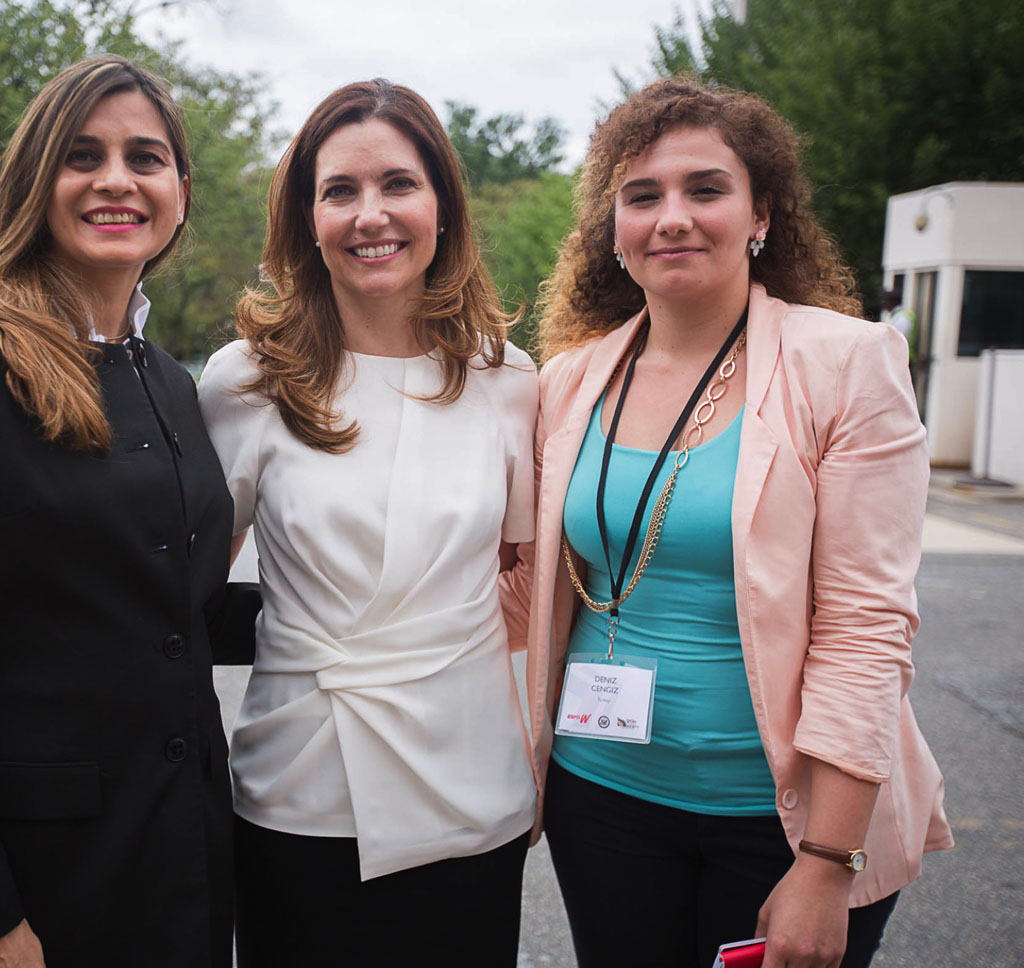
Meet and support global leaders creating change in Turkey:
Deniz Cengiz
Kiraz Öcal
How does Turkey compare to other countries?
Where do you want to explore next?
Women in Leadership
PERCENTAGE OF WOMEN IN PARLIAMENT AS OF 2020
18%
PERCENTAGE OF WOMEN IN MINISTRY POSITIONS AS OF 2020
12%
Has a Woman Ever Been Head of State or Head of Government?
Tansu Çiller, 1993-1996
HAS A WOMAN EVER BEEN SPORTS MINISTER?
Unknown
Title IX Timeline


1923
The Turkish War of independence, which began on 19 May 1919, ended on 24 July 1932 resulting in Turkey gaining independence from the Ottoman Empire.
1930
Women gained the right to vote (full suffrage).
1936
Suat Aşeni and Halet Çambel, fencing athletes, become the first women to represent Turkey in the Olympics.
1985
Turkey ratified the Convention on the Elimination of All Forms of Discrimination against Women (CEDAW).
1992
Hülya Şenyurt became the first woman from Turkey to win an Olympic medal (bronze- judo).
1993
Tansu Çiller became the first female prime minister of Turkey.
2002
Turkey ratified the optional protocol to CEDAW.
2004
Neslihan Kavas, a table tennis athlete, became the first woman to represent Turkey in the Paralympics.
2008
Gizem Girişmen (gold- archery) and Neslihan Kavas (bronze- para table tennis) became the first women from Turkey to win Paralympic medals.

Women in the olympics
participation through the years
-
2
-
1
-
3
-
2
-
6
-
14
-
58
-
120
-
50
Women in the Paralympics
participation through the years
-
0
-
0
-
0
-
0
-
9
-
54
-
44
Elite Sports Participation
First Year Women Participated In The Olympics
1936
Year Women’s Participation In Olympics Was Equal To Men’s
2006
First Time A Woman Won An Olympic Medal
Hülya Şenyurt: 1992, Judo (Bronze)
First Year Women Participated In The Paralympics
2004
Year Women’s Participation In Paralympics Was Equal To Men’s
2008
First Time A Woman Won A Paralympic Medal
Gizem Girişmen: 2008, Archery (Gold) Neslihan Kavas: 2008, Table Tennis (Bronze)

FIFA
Fédération Internationale de Football Association
National Women’s Team?
Yes
First Year Of Play
1995
Pay Gap Comparison
Pay Unknown
Gender Initiatives
FIFA is committed to the growth and development of women’s football around the globe.
For More Information
FIBA
Fédération Internationale de Basketball
National Women’s Team?
Yes
First Year Of Play
1988
Pay Gap Comparison
Pay Unknown
Gender Initiatives
Increasing the participation of women in basketball at all levels was named as one of FIBA’s eight strategic objectives (2019- 2027) and one of FIBA’s three strategic priorities (2019-2023).
For More Information
LOCAL
Sports
Initiatives
Community Organizations That Have Signed The Brighton + Helsinki Declaration
Turkish Rugby, Baseball, Softball and American Football Federation
